Beginner Tips for Japanese Conversations

Starting to speak Japanese can feel like stepping into a whole new world. The language has a unique rhythm and structure that might seem tricky at first. But with the right approach, you can quickly build confidence and enjoy meaningful conversations. Here, I share practical tips to help you get started with beginner Japanese conversation.
Getting Comfortable with Basic Japanese Conversation
The first step is to get comfortable with simple phrases. Focus on greetings and common expressions. These are the building blocks of any conversation.
Start with greetings like "こんにちは" (Konnichiwa - Hello) and "おはようございます" (Ohayou gozaimasu - Good morning).
Learn polite phrases such as "ありがとうございます" (Arigatou gozaimasu - Thank you) and "すみません" (Sumimasen - Excuse me / Sorry).
Practice introducing yourself: "はじめまして、[Your Name] です" (Hajimemashite, [Your Name] desu - Nice to meet you, I am [Your Name]).
Using these phrases regularly helps you feel more natural when speaking. Try to say them out loud every day.

Essential Tips for Beginner Japanese Conversation
When you start talking, keep your sentences short and clear. Japanese often uses simple sentence structures, especially in casual conversation.
Use subject-object-verb order. For example, "I eat sushi" becomes "わたしはすしをたべます" (Watashi wa sushi o tabemasu).
Don’t worry about perfect grammar at first. Focus on getting your message across.
Listen carefully to how native speakers use particles like は (wa), を (o), and が (ga). These little words show the relationship between parts of a sentence.
Practice common question words: 何 (nani - what), どこ (doko - where), いつ (itsu - when), and どうして (doushite - why).
Remember, practice makes perfect. Try to use new words and phrases in your daily life or language exchanges.
Using Polite and Casual Speech Appropriately
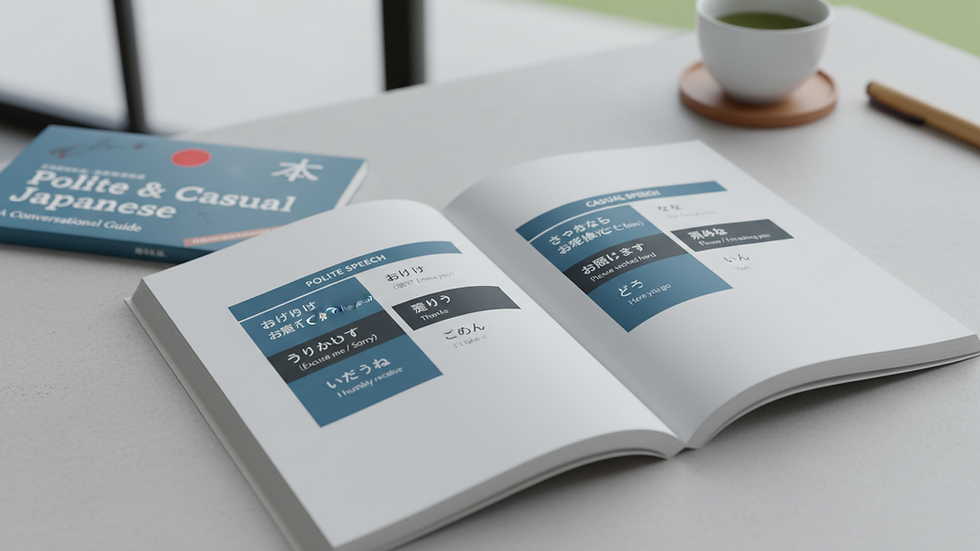
Japanese has different levels of politeness. Knowing when to use polite or casual speech is key to sounding natural.
Use polite form (ます/です endings) with strangers, in business, or with people older than you.
Use casual form with friends and family.
For example, polite: "行きます" (ikimasu - I go), casual: "行く" (iku).
When in doubt, start polite. It’s safer and shows respect.
This balance helps you fit in better and avoid awkward moments.
Practice Listening and Speaking Regularly
Listening is just as important as speaking. The more you hear Japanese, the easier it becomes to understand and respond.
Watch Japanese shows, listen to podcasts, or use language apps.
Repeat phrases you hear to improve your pronunciation.
Join language exchange groups or find conversation partners online.
Don’t be afraid to make mistakes. Native speakers appreciate your effort.
One great way to improve is to immerse yourself in real conversations. This helps you learn natural expressions and slang.
Building Your Vocabulary for Everyday Situations
Having a good vocabulary helps you express yourself clearly. Start with words related to daily life.
Learn numbers, days of the week, and common verbs.
Focus on words for food, transportation, and shopping.
Use flashcards or apps to review regularly.
Try to use new words in sentences to remember them better.
For example, when ordering food, you can say: "これをください" (Kore o kudasai - Please give me this).
Keep Your Japanese Conversation Skills Growing
The key to success is consistency. Set small goals like learning five new words a day or having a short conversation once a week.
Use resources like online courses or apps to guide your learning.
Practice speaking with native speakers whenever possible.
Keep a journal of new phrases and review them often.
Celebrate your progress, no matter how small.
If you want to explore more tips and resources, check out Kotoba Garden Japanese, a great place to learn real, natural Japanese.
With these beginner tips for Japanese conversations, you can start speaking with confidence. Remember, every conversation is a step forward. Keep practicing, stay curious, and enjoy the journey of learning this beautiful language!


Comments